energy points on feet, foot reflexology points, foot acupressure points
Energy Points on the Feet in Reflexology: Maps, Meridians, and Safe Practice
Explore energy points on the feet, reflexology zones, six traditional acupressure landmarks, safe pressure technique, anatomy, evidence, and precautions.
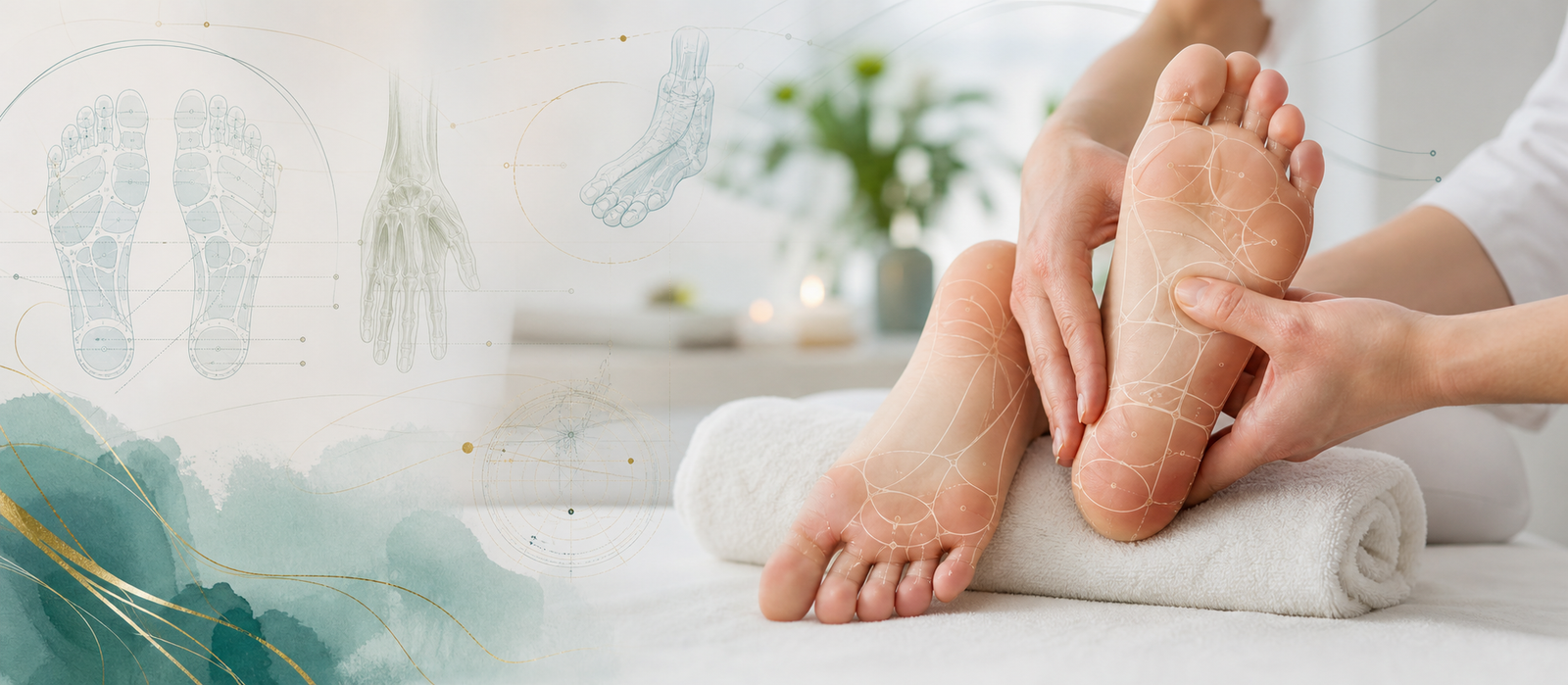
Energy Points on the Feet: A Clear Starting Point
People often use the phrase energy points on the feet as if it described one universal map. In practice, it can refer to three different systems: reflexology zones that are believed to correspond with body regions, acupuncture or acupressure points located along traditional meridians, and ordinary anatomical areas that feel sensitive because they contain nerves, fascia, tendons, joints, or pressure-loaded tissue.
These systems may overlap during a modern foot reflexology session, but they are not interchangeable. A reflex area is not automatically an acupuncture point, and a tender spot does not reveal which organ is healthy or unwell. The most useful approach is to understand each map, apply pressure gently, and describe the result as comfort, relaxation, or sensory stimulation rather than diagnosis or cure.
Key Takeaways
- Reflexology zones, acupuncture points, and anatomical tender areas come from different explanatory systems.
- Six commonly discussed traditional landmarks around the foot are KI1, LR3, SP4, GB41, BL60, and KI3.
- Point locations can guide a wellness sequence, but they cannot diagnose organ dysfunction.
- Use slow, broad, tolerable pressure and stop for sharp, electric, burning, or spreading sensations.
- Wounds, infection, acute injury, unexplained swelling, reduced sensation, and high-risk diabetic feet require caution or medical assessment.
Table of Contents
Three Maps That Are Often Confused
1. Reflexology zones
Reflexology treats the foot as a small map of the whole body. Most Western charts place the head and neck around the toes, the chest near the ball of the foot, abdominal regions through the arch, and pelvic or lower-body regions around the heel. The inner edge is commonly associated with the spine. These are traditional correspondences, not direct anatomical connections.
2. Acupuncture and acupressure points
Traditional Chinese medicine describes named points along channels or meridians. Acupuncture stimulates these sites with needles; acupressure uses non-penetrating pressure. The World Health Organization standardized point names and surface locations to support consistent teaching and research. Standardization tells us where a point is located; it does not by itself prove every traditional indication attached to that point.
3. Anatomical sensitivity
The sole is richly supplied by the medial and lateral plantar nerves and contains layered muscles, tendons, fat pads, joints, and plantar fascia. The dorsum has thinner soft tissue and different superficial nerves. A spot may therefore feel intense because of load, footwear, tissue irritation, nerve sensitivity, or individual anatomy. Sensitivity is useful feedback, but it is not a hidden organ test.
How to Orient Yourself on the Foot
Plantar means the sole; dorsal means the top of the foot. The medial side is the big-toe side and the lateral side is the little-toe side. The malleoli are the ankle bones, while the calcaneal tendon is the Achilles tendon. Use these landmarks rather than guessing from a flat diagram, because foot size and shape vary.
Find a point with light contact first. Do not dig for it. Compare both feet, remember that perfect symmetry is unusual, and treat the described location as a small area rather than a pin-sized target.
Six Traditional Foot and Ankle Points
The names below belong to acupuncture nomenclature, even when a reflexologist includes them in a manual session. The traditional uses are cultural and clinical concepts from acupuncture practice; they should not be presented as proof that pressing the point treats a disease.
KI1, Yongquan or "Bubbling Spring"
KI1 is on the sole, near the junction of the front third and back two-thirds of the foot, in a depression that becomes easier to notice when the toes flex. It is the best-known plantar acupoint and is traditionally discussed in grounding or settling routines. For self-pressure, use a broad thumb pad for 15 to 30 seconds. Avoid a hard vertical jab into the sole.
LR3, Taichong or "Great Rushing"
LR3 lies on the top of the foot between the first and second metatarsal bones. Start near the web between the big and second toes and move gently toward the ankle until the bones begin to converge. It is traditionally used in point-based routines concerned with movement and regulation. Pressure should remain light because the dorsum has little cushioning and important vessels and nerves lie nearby.
SP4, Gongsun or "Grandfather-Grandson"
SP4 is on the inner side of the foot, just in front of and below the base of the first metatarsal. It is traditionally associated with the Spleen channel and digestive-themed acupressure sequences. That language describes the traditional system, not the anatomical spleen. Use slow contact along the soft border of the bone and never press through sharp pain.
GB41, Zulinqi or "Foot Governor of Tears"
GB41 is on the top of the foot between the fourth and fifth metatarsal bones, near the point where their bases approach each other. It appears in traditional lateral-body and mobility-oriented point combinations. Locate it gently from the space between the fourth and fifth toes, moving toward the ankle. Avoid strong pressure over swelling, a recent sprain, or suspected stress injury.
BL60, Kunlun
BL60 sits in the hollow between the outer ankle bone and the Achilles tendon. It is an ankle landmark rather than a sole reflex point and is often discussed in traditional back and lower-limb routines. Pinch or squeeze techniques are unnecessary: a soft fingertip hold is sufficient. Do not press an injured tendon, swollen ankle, or acutely painful joint.
KI3, Taixi or "Great Stream"
KI3 mirrors BL60 on the inner ankle, in the depression between the medial ankle bone and the Achilles tendon. It is traditionally used in Kidney-channel practice, but the word "Kidney" names a traditional channel and does not mean that tenderness diagnoses kidney disease. Keep pressure shallow and avoid the area when there is unexplained swelling, vascular concern, or tendon pain.
Where Reflexology's "Energetic" Zones Fit
A reflexologist may work the diaphragm line across the foot near the lower edge of the ball, then pause around a central area often called the solar plexus reflex. This is a reflexology landmark, not KI1 and not a universally standardized acupuncture point. Charts differ slightly, so it is more accurate to describe a zone than to promise a precise energetic switch.
In a session, these areas can organize pacing: toes for fine, lighter work; the ball for broad pressure; the arch for thumb walking; the heel for slower compression; and the inner edge for careful linear work. Their practical value is consistency and attentive touch. They do not create a medically validated map of the organs.
How to Work With Energy Points During Reflexology
- Screen before touching. Ask about pain, injury, surgery, diabetes, neuropathy, circulation, pregnancy, medication, wounds, and the person's pressure preference.
- Inspect both feet. Look for color or temperature differences, swelling, broken skin, bruising, fungal changes, and areas the person does not want touched.
- Warm the whole foot. Use palm contact, gentle ankle movement, and broad strokes. Beginning with a single intense point can provoke guarding.
- Move from zones to points. Work the sole broadly, then explore one or two landmarks with a thumb pad or fingertip. Build pressure gradually.
- Hold instead of poking. Apply steady pressure for roughly 15 to 30 seconds while the person breathes normally. Release slowly and reassess.
- Close the session. Return to broad contact, smooth from toes toward heel, and ask whether anything feels numb, sore, dizzy, or unusually sensitive.
A moderate sensation can be acceptable, but the person should remain able to relax. Sharp, burning, electric, numb, or spreading sensations are stop signals. More pain does not mean more blocked energy is being released.
What Science Can and Cannot Say About Energy Points
NCCIH defines reflexology as pressure applied to specific points on the feet or hands that are believed to correspond with other body parts, while noting that healing effects in those corresponding parts have not been proven. This means a reflexology chart can be taught as a traditional practice map, but not as a diagnostic instrument.
Research on acupuncture is broader, yet it does not provide a simple confirmation of invisible meridians. NCCIH reports that possible effects may involve the nervous system, local connective tissue, and nonspecific factors such as expectation and the therapeutic interaction. Acupuncture evidence also cannot be transferred automatically to thumb pressure during reflexology: the techniques, dose, training, and study conditions differ.
An interesting 2024 anatomical study examined KI1 in six cadavers and found the area close to branches of the medial and lateral plantar nerves and related foot muscles. This gives researchers a plausible anatomical target for studying stimulation. It does not prove that KI1 controls distant organs or that tenderness at the point identifies illness. Anatomy can explain why touch there feels distinct without turning sensation into diagnosis.
Reviewed August 30, 2026
2026 Practice Update: Precision Means Better Boundaries
Recent research is moving toward more precise descriptions of where point stimulation occurs and which nerves or tissues may be involved. At the same time, current clinical foot-care guidance keeps attention on protective sensation and skin integrity. The 2026 American Diabetes Association standards emphasize regular foot evaluation and daily inspection for people at risk.
For reflexology education, the useful update is simple: identify the traditional map accurately, describe the tissue being touched, record the pressure and response, and avoid unsupported organ claims. Better location language should improve safety and research quality, not increase certainty beyond the evidence.
Safety, Contraindications, and Referral
Do not apply point pressure over an open wound, ulcer, burn, active skin infection, suspected fracture, acute sprain, inflamed tendon, or unexplained hot and swollen area. Sudden one-sided swelling, calf pain, spreading redness, fever, new weakness, or shortness of breath requires medical attention rather than reflexology.
People with diabetes, neuropathy, peripheral artery disease, a previous foot ulcer or amputation, fragile skin, impaired healing, anticoagulant use, or reduced sensation need individualized advice. Pain is not a reliable safety signal when protective sensation is reduced. Pregnancy is not automatically a reason to avoid all foot touch, but point-based treatment should be gentle, consent-led, and discussed with the maternity team when the pregnancy is high risk.
Use clean hands, short nails, and no needles. Acupuncture should only be performed by an appropriately trained and licensed professional using sterile, single-use needles.
A Ten-Minute Educational Foot Routine
- Minutes 0-2: Inspect the foot, establish comfortable pressure, and warm the sole with broad palm contact.
- Minutes 2-4: Use slow thumb walking through the arch and gentle circles across the ball of the foot.
- Minutes 4-6: Hold KI1 lightly on the sole, then explore either LR3 or GB41 on the top of the foot.
- Minutes 6-8: Trace the medial edge with broad contact and, if the ankle is healthy, touch KI3 or BL60 gently.
- Minutes 8-10: Mobilize the toes softly, smooth the whole foot, and compare comfort before and after.
Choose fewer points when learning. A calm sequence with accurate landmarks is more educational than pressing every named point. Repeat on the other foot only if the first side remains comfortable, and stop if symptoms worsen.
Common Mistakes to Avoid
- Calling every sore spot a blockage: soreness may reflect pressure, footwear, load, injury, or nerve sensitivity.
- Mixing maps without labels: state whether you are using a reflex area, an acupoint, or an anatomical landmark.
- Pressing harder to get a reaction: bruising and guarding are not evidence of a better session.
- Diagnosing from the feet: skin, sensation, circulation, and pain changes may warrant healthcare assessment, not an organ interpretation.
Recommended Reading Path
Frequently Asked Questions
Are foot energy points the same as reflexology points?
Not always. "Energy point" may refer to a traditional acupoint on a meridian, while reflexology usually uses broader body-correspondence zones. A modern session may include both, but they should be named accurately.
What is the main energy point on the sole?
KI1, or Yongquan, is the best-known traditional acupoint on the sole. Reflexologists may also discuss a solar plexus reflex nearby, but the two labels come from different maps.
How long should I press a foot point?
For gentle self-care, a slow hold of about 15 to 30 seconds is enough to observe the sensation. Release sooner if the feeling becomes sharp, electric, burning, numb, or unpleasant.
Does tenderness at a reflexology point mean an organ problem?
No. Tenderness is not a validated organ test. It can reflect local tissue load, footwear, injury, sensitivity, expectation, or normal variation.
Can reflexology unblock energy?
"Unblocking energy" is traditional wellness language, not a measurable medical diagnosis. A careful article can respect that interpretation while describing observable outcomes such as relaxation, comfort, and awareness of the feet.
Can I use these points if I have diabetes?
Ask your diabetes or foot-care clinician first if you have neuropathy, poor circulation, a previous ulcer, reduced sensation, or other high-risk features. Strong pressure and tools are inappropriate when the foot cannot reliably detect injury.
Scientific, Medical, Therapeutic, and Book References
Online references
- NCCIH: Reflexology. Definition of reflexology and evidence limits for body-correspondence claims.
- WHO Standard Acupuncture Point Locations in the Western Pacific Region. Standard names and surface locations for traditional acupuncture points.
- NCCIH: Acupuncture: Effectiveness and Safety. Current evidence, possible mechanisms, and safety context.
- Kim et al. (2024): Anatomical Exploration of the KI1 Acupoint. Cadaveric investigation of KI1 in relation to plantar muscles and nerves.
- NCBI Bookshelf: Foot and Ankle Anatomy. Overview of plantar and dorsal tissues and innervation.
- ADA Standards of Care in Diabetes 2026: Neuropathy and Foot Care. Current high-risk foot assessment and self-care guidance.
Book references
- Ingham, E. Stories the Feet Can Tell Thru Reflexology. Historical reflexology reference.
- Dougans, I. The Complete Illustrated Guide to Reflexology. Reflexology maps and practice reference.
- Marquardt, H. Reflexotherapy of the Feet. Professional reflex-zone therapy reference.