Back pain acupressure points, safety, and self-care
How to Use Acupressure for Back Pain: A Safety-Led Pressure Point Guide
Learn a safety-led acupressure routine for back pain with hand, lower back, hip, knee, calf, and foot points, red flags, pressure rules, and professional diagrams.
Use Acupressure for Back Pain with a Safety Frame First
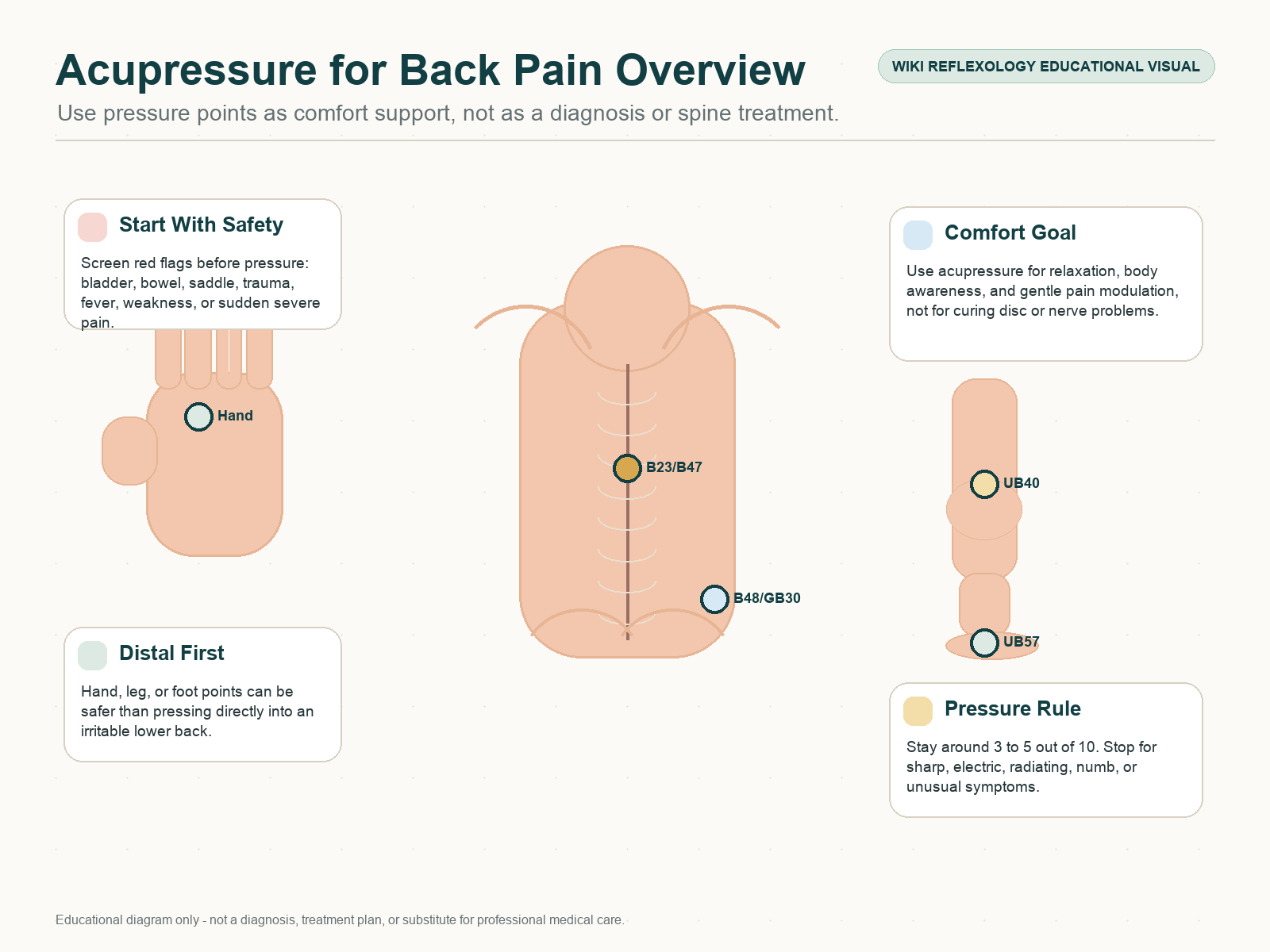
Acupressure for back pain is popular because it is simple, low-cost, and easy to try at home: press a point on the hand, lower back, hip, leg, or foot, breathe, and notice whether the back feels calmer. The public WikiHow article on using acupressure for back pain introduces several traditional points, including hand points, lumbar points, hip points, the back of the knee, the calf, and the top of the foot. This Wiki Reflexology guide keeps that beginner-friendly structure, but rebuilds it into a more professional, medically cautious, and educational article.
The first upgrade is scope. Acupressure may be a useful comfort routine for mild, familiar back discomfort, protective muscle tension, stress-related guarding, or a short self-care break. It is not a diagnostic system. It cannot tell whether back pain comes from a muscle strain, disc irritation, inflammatory disease, kidney problem, fracture, infection, cancer, spinal stenosis, pregnancy-related condition, or nerve compression. A tender point does not prove a diagnosis.
The second upgrade is safety. Back pain is common and often improves over time, but some back pain needs medical assessment. Stop self-care and seek urgent help for red flags such as new loss of bladder or bowel control, numbness around the saddle area, progressive leg weakness, pain or numbness in both legs, fever, severe sudden pain, major trauma, chest pain, unexplained weight loss, cancer history, infection risk, or symptoms that are rapidly worsening. Acupressure should never delay care for those signs.
Editorial note: the WikiHow article was used as a topic reference only. This article is original, substantially expanded, and rebuilt with professional diagrams, clearer point-location logic, pressure rules, red flags, pregnancy cautions, self-care routines, and medical references.
Professional Visual Set
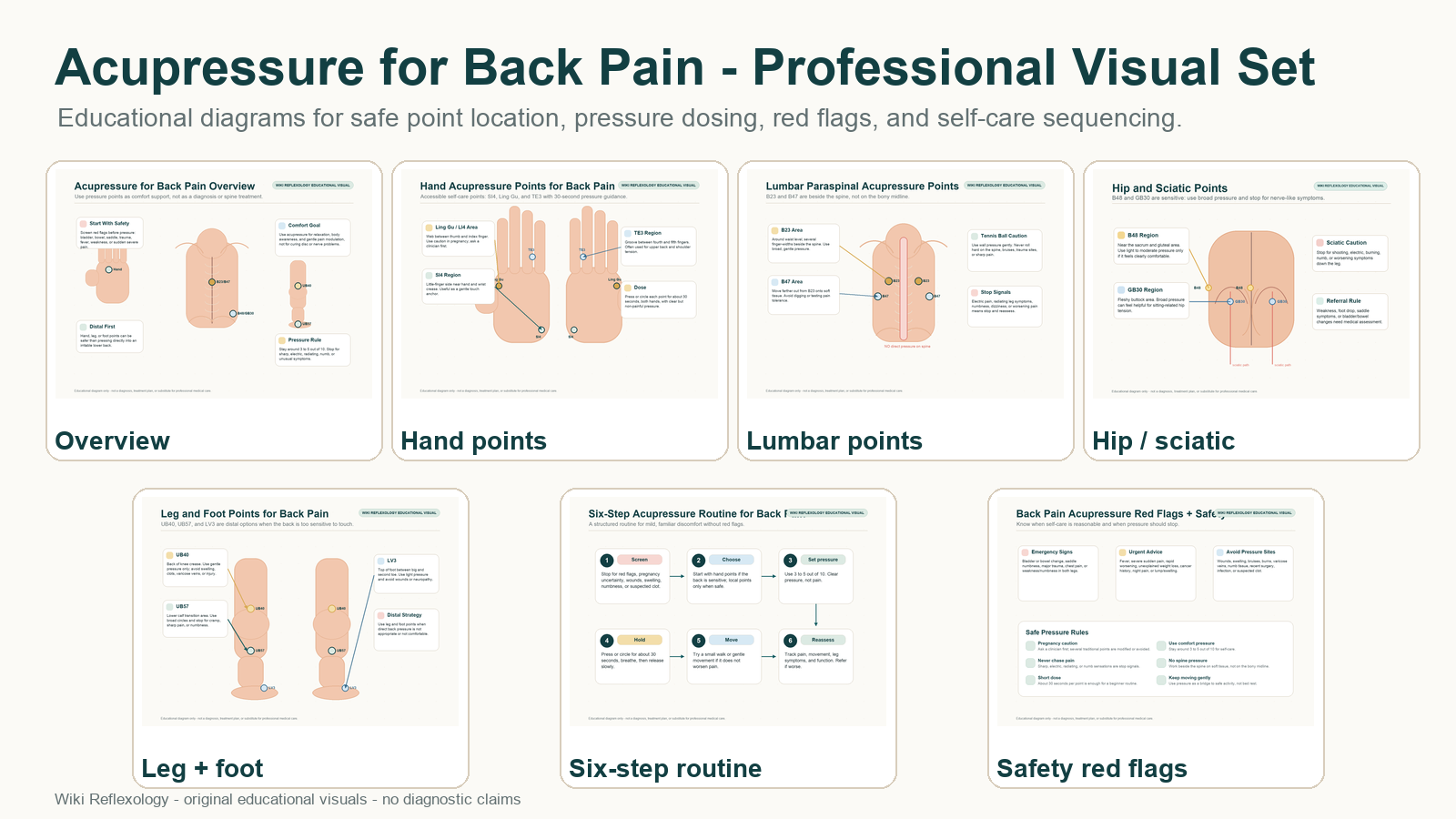
These diagrams are designed for education, not diagnosis. They show traditional acupressure point families for back pain, including hand points, lumbar paraspinal points, hip and sciatic-area points, leg and foot points, routine sequencing, and safety red flags.
What Acupressure Can and Cannot Do for Back Pain
Acupressure is a touch-based practice related to acupuncture and traditional Chinese medicine. Instead of needles, it uses fingers, thumbs, palms, or simple tools to stimulate mapped points. Some points are local, meaning they sit near the painful region. Others are distal, meaning they are on the hand, leg, or foot but traditionally used for back, hip, or general pain patterns.
For back pain, a realistic goal is comfort support. Acupressure may help a person slow their breathing, reduce stress arousal, soften muscle guarding, and become more aware of posture and movement. It may also create a structured pause in a day that includes sitting, driving, lifting, or screen work. These effects can matter, especially when pain is mild and familiar.
Acupressure should not be marketed as a cure for sciatica, disc herniation, spinal arthritis, ankylosing spondylitis, fracture, kidney pain, infection, or nerve damage. Even when acupuncture has better clinical evidence than acupressure for some low back pain contexts, the exact evidence for self-acupressure varies by protocol, population, study quality, and outcome. That is why this article uses careful language: acupressure may support comfort; it does not replace diagnosis or evidence-based care.
Back Pain Red Flags Come Before Point Selection
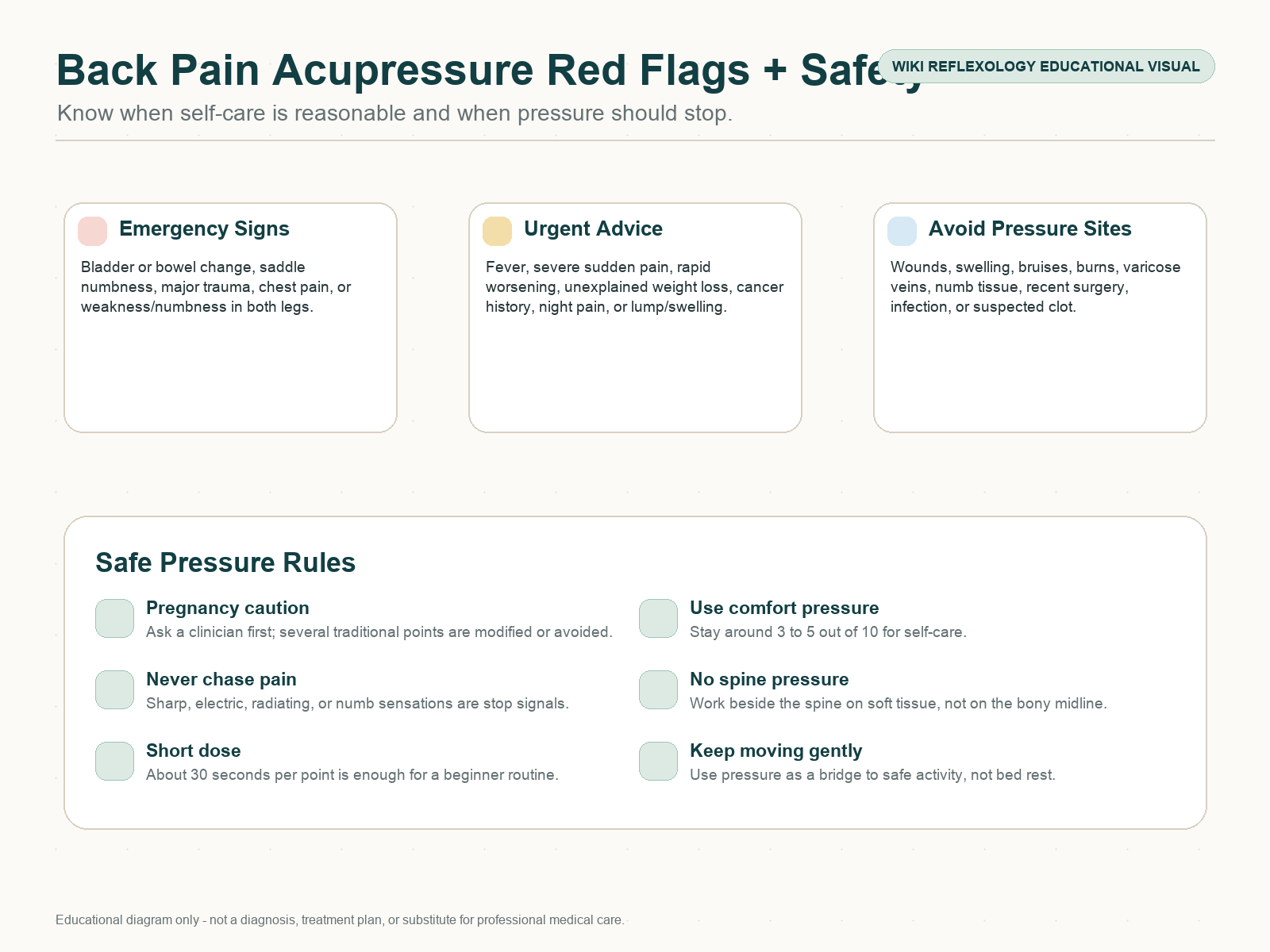
Before choosing a point, decide whether self-care is appropriate. For mild, familiar, non-traumatic back discomfort, a gentle routine may be reasonable. For severe, new, progressive, neurological, traumatic, infectious, or medically unexplained back pain, the safest next step is assessment rather than pressure.
Emergency warning signs include new bladder or bowel changes, saddle numbness, major accident or fall, rapidly worsening leg weakness, pain with numbness or tingling in both legs, chest pain, or symptoms that make walking unsafe. Urgent medical advice is also appropriate for fever, feeling unwell, unexplained weight loss, cancer history, pain worse at night or not helped by rest, a new lump or swelling, severe sudden pain, or pain that is stopping normal daily activities.
There are also pressure-point cautions. Do not use acupressure over wounds, rashes, bruises, burns, inflamed skin, swollen tissue, recent surgery, suspected clot, varicose veins, numb areas, areas with reduced sensation, or sites that produce sharp, electric, radiating, or unusual pain. If you are pregnant or might be pregnant, ask a medical professional before using acupressure for back pain; several traditional points are avoided or modified in pregnancy.
Hand Acupressure Points for Back Pain: SI4, Ling Gu, and TE3
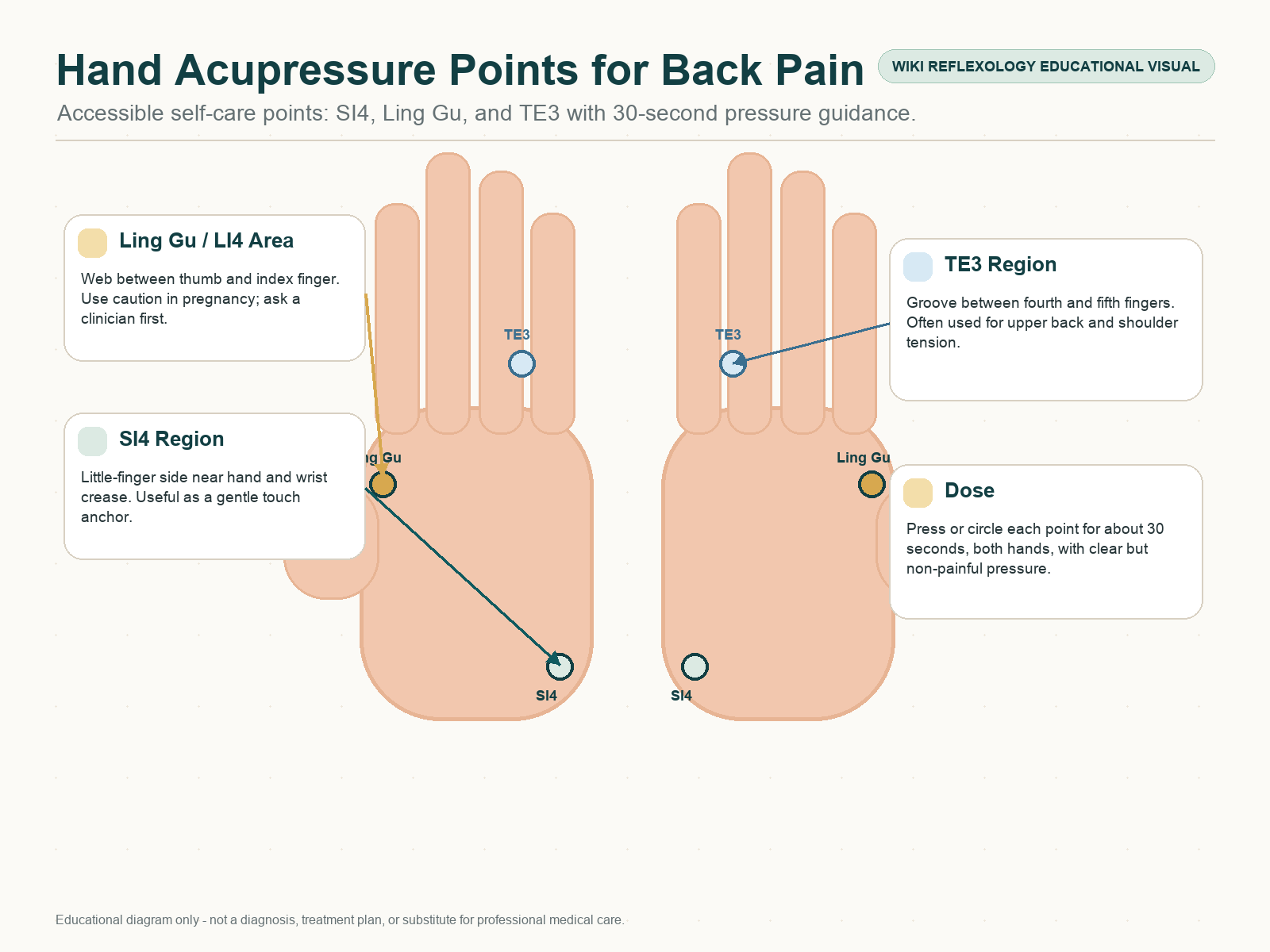
The WikiHow reference starts with hand points, which is practical because they are easy to reach and safer than pressing directly into an irritable lower back. Three hand regions are commonly discussed in public acupressure routines: Small Intestine 4 near the little-finger side of the hand and wrist, Ling Gu in the web between thumb and index finger, and Triple Energizer 3 in the groove between the fourth and fifth fingers.
In traditional language, these points are used for neck, shoulder, upper back, lower back, headache, or general pain patterns depending on the system. In modern safety language, they are best understood as accessible touch anchors. They let the reader pause, breathe, apply comfortable pressure, and notice whether the body downshifts from guarding.
To work them, use the opposite thumb or index finger. Apply steady pressure or small circles for about 30 seconds, then release slowly. Repeat on both hands. Pressure should feel clear and tolerable, not sharp. Avoid hand pressure over injury, inflammation, numbness, recent surgery, active arthritis flare, or skin irritation. If Ling Gu or any web-space point is used during pregnancy, professional guidance is especially important because some traditional hand points are avoided in pregnancy.
Lower Back Acupressure Points: B23 and B47
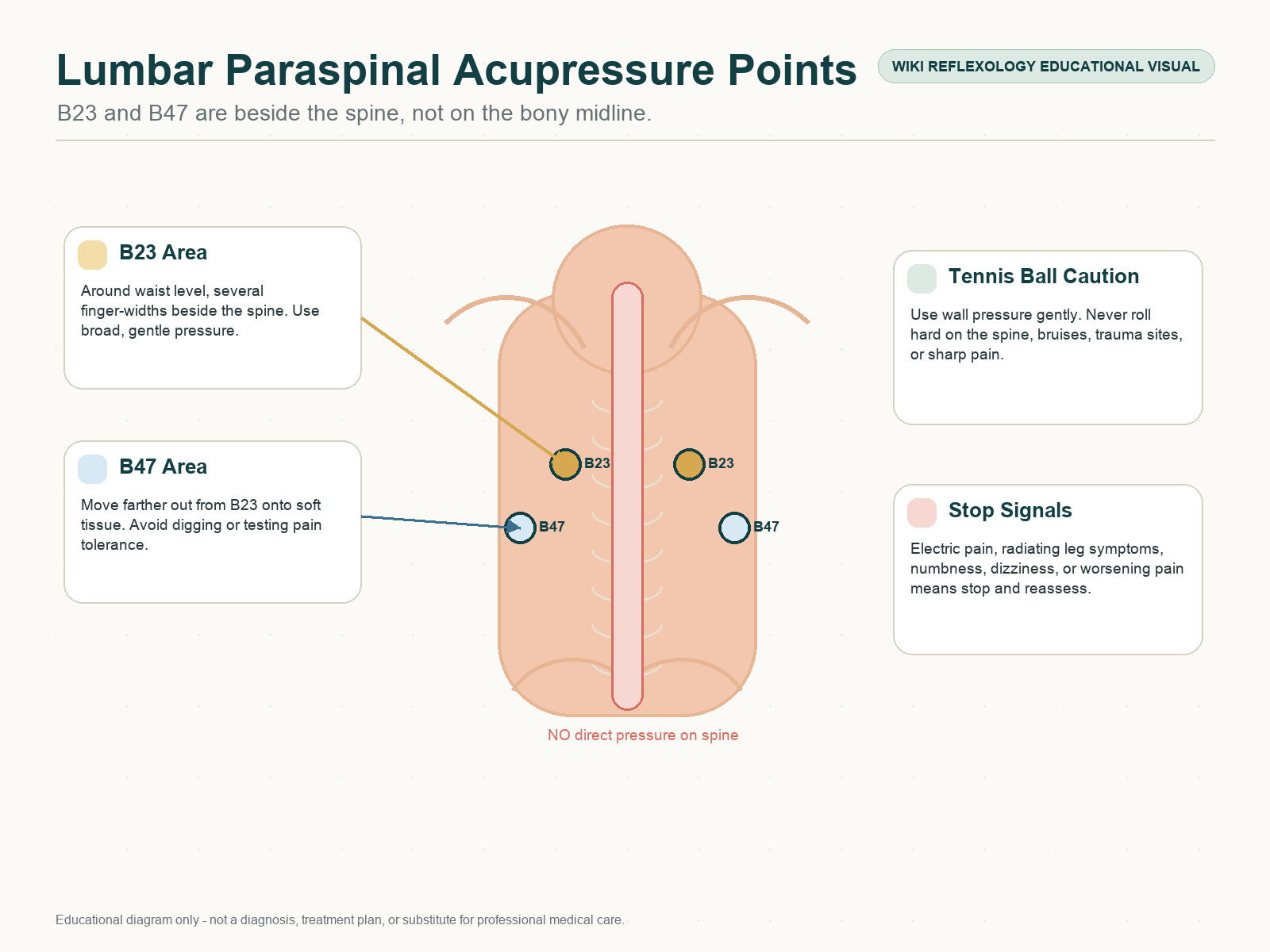
The lower back points in the WikiHow article include Kidney Shu, often labeled B23, and Bladder 47, often labeled B47. These are local points beside the spine. They are traditionally used for lower back discomfort and are located around waist level, several finger-widths away from the midline. The most important safety rule is simple: do not press on the spine itself.
For self-care, these points can be hard to reach accurately. If you use them, work broad and gentle rather than narrow and aggressive. Place the thumbs or knuckles beside the lumbar spine, stay on muscle tissue, and avoid the bony midline. Press for 20 to 30 seconds, release, and reassess. A tennis ball against the wall can be used cautiously for broad pressure, but it should never create sharp, electrical, or radiating symptoms.
Do not use deep pressure on the lower back after trauma, over bruising, over recent surgery, during unexplained severe pain, or when symptoms travel down the leg with weakness or numbness. Do not ask an untrained person to dig into the lumbar spine. If a point seems to reproduce nerve-like pain, stop; that is a referral signal, not proof that the point is working.
Hip and Sciatic-Area Points: B48 and GB30
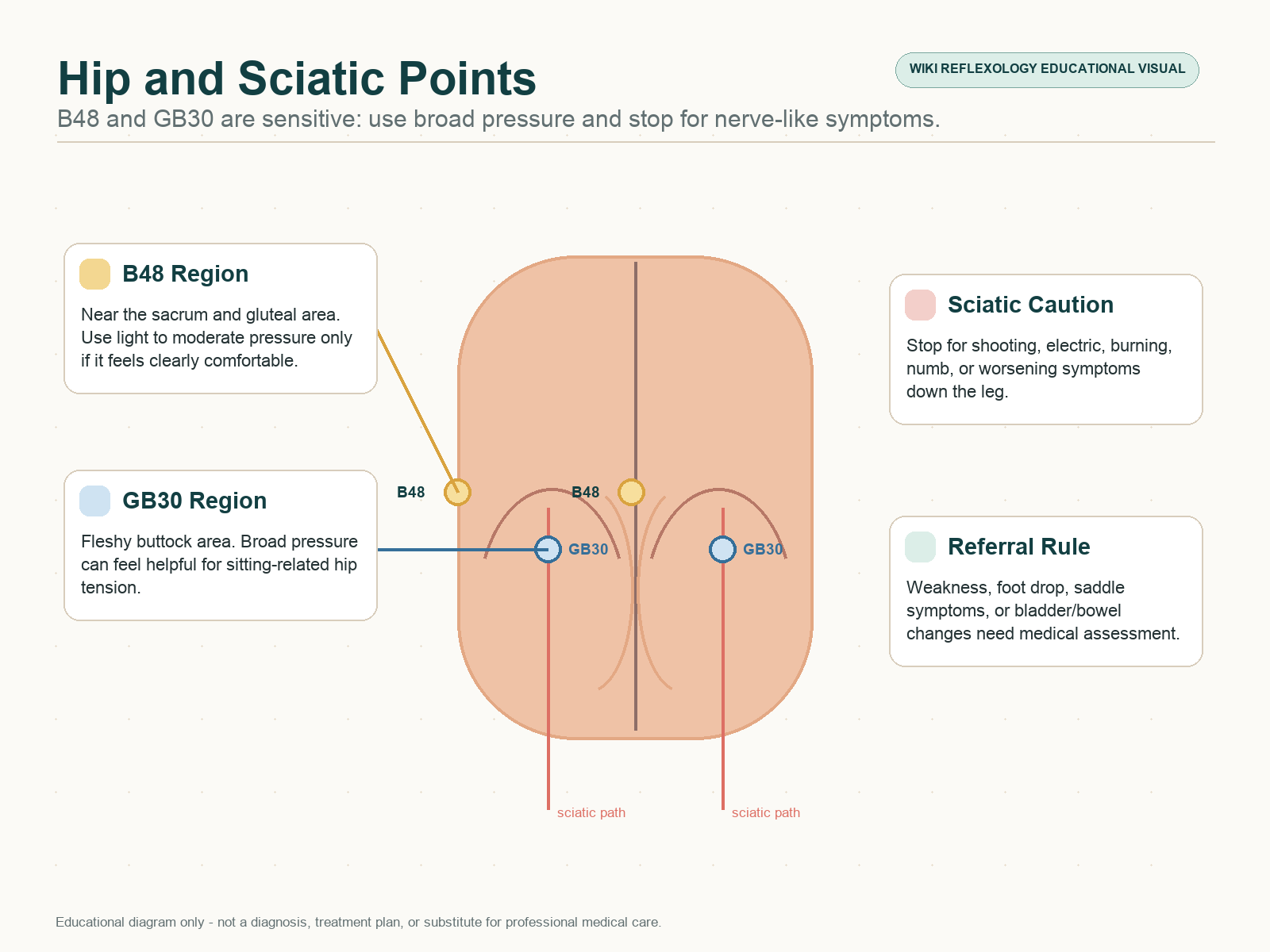
The hip and buttock points often appear in back pain acupressure because many people feel lower back pain together with hip tension or sciatic-type discomfort. B48 is commonly described near the sacrum and gluteal region. GB30 is often described in the fleshy part of the buttock, near the line between the hip and the lower buttock. These points may feel useful for seated workers with gluteal tightness, but they require caution.
The sciatic nerve runs through the buttock region and down the back of the leg. Pressing too hard into the buttock can irritate sensitive tissue or reproduce nerve-like symptoms. Use broad thumb, palm, or ball pressure only if it feels comfortable. Pressure should feel dull, warm, or relieving. It should not feel electric, shooting, burning, or numb.
If pain travels below the knee, if there is weakness, numbness, foot drop, saddle symptoms, or bladder or bowel changes, do not use hip points as a workaround. Get medical assessment. Acupressure may be a comfort layer for familiar muscle tension, but it is not a treatment for progressive nerve compression.
Leg and Foot Points: UB40, UB57, and LV3
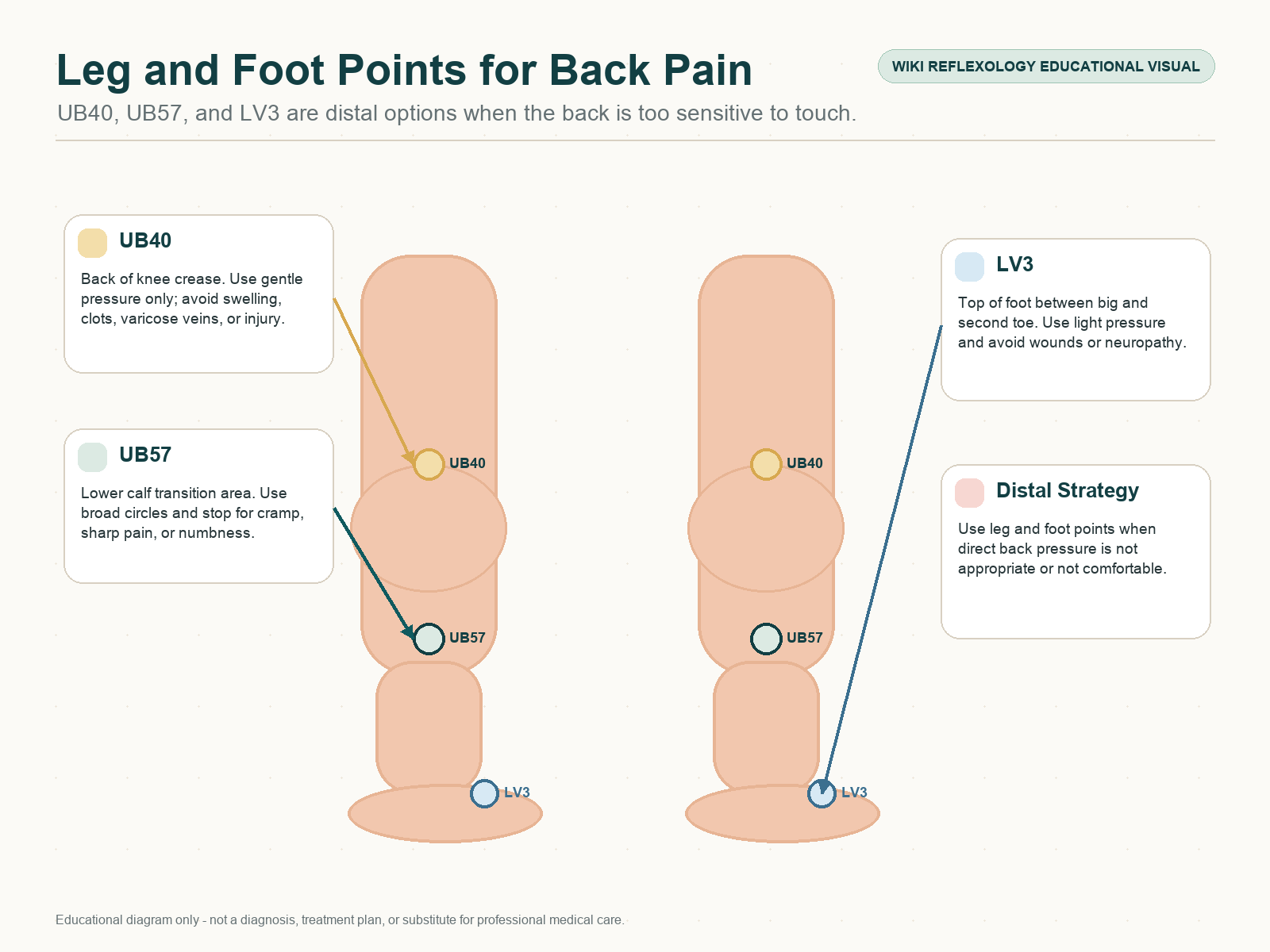
Distal points can be useful when the lower back is too sensitive to touch. The WikiHow article includes the back of the knee, the lower calf, and the top of the foot. UB40 is commonly described at the back of the knee crease. UB57 is commonly placed in the lower calf, around the transition where the calf muscle narrows toward the Achilles tendon. LV3 is usually located on the top of the foot between the big toe and second toe.
Use these points gently. Behind the knee is a sensitive area with nerves and blood vessels, so avoid aggressive pressure. Do not press behind the knee if there is swelling, a suspected clot, varicose veins, recent injury, or unexplained calf pain. For the calf, use broad contact and stop for cramping, sharp pain, or numbness. For the top of the foot, work lightly and avoid areas with reduced sensation, ulcers, wounds, inflammation, or neuropathy.
A simple routine is 30 seconds per point on both sides, then reassess. If the distal points help the back feel less guarded, they can be used as a short break. If they do nothing, that is not a failure; back pain is multifactorial, and a pressure point is only one tool.
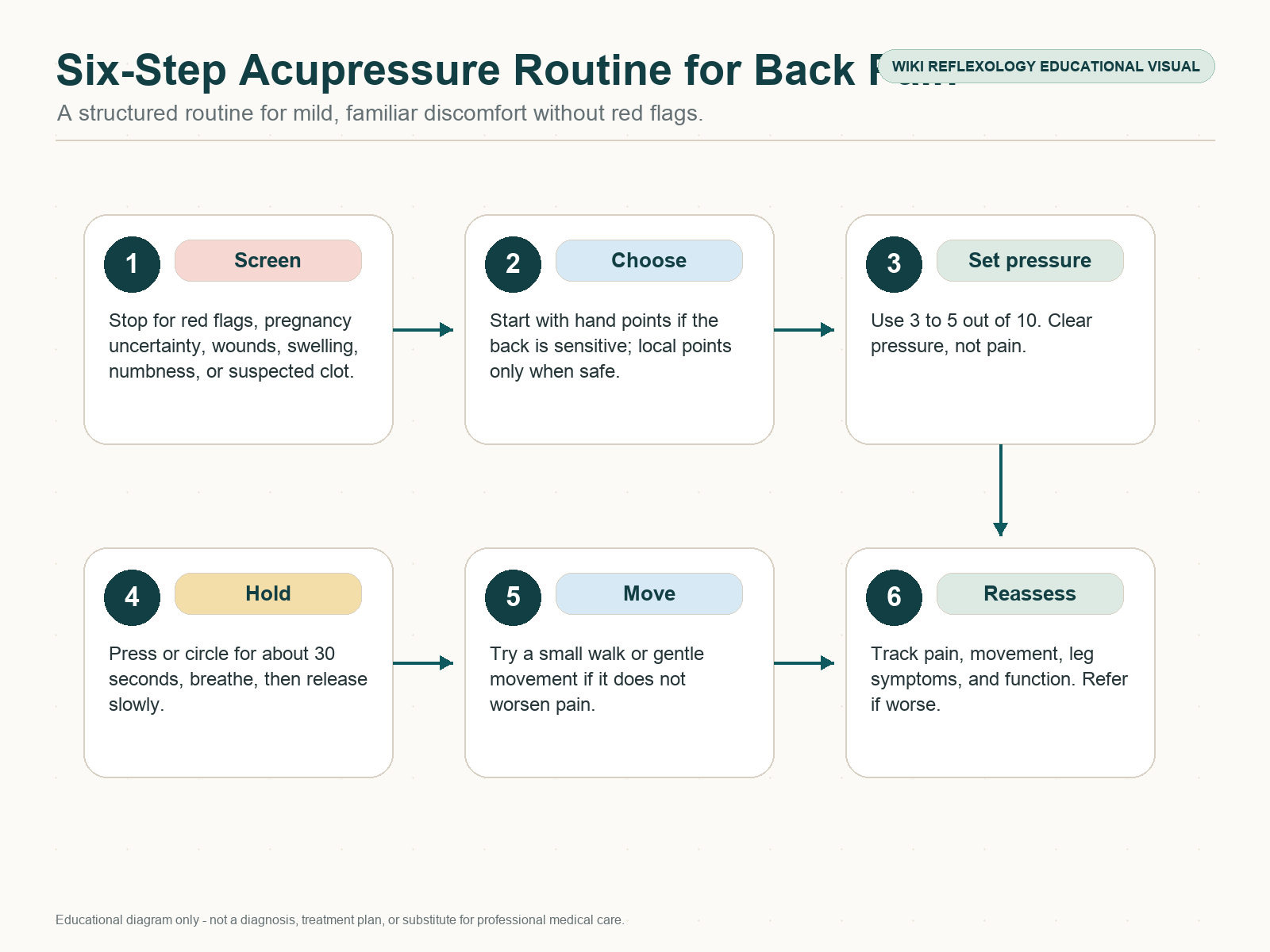
A Six-Step Acupressure Routine for Back Pain Comfort
This routine is designed for mild, familiar back discomfort without red flags. It is not for major trauma, severe sudden pain, neurological symptoms, fever, unexplained weight loss, bladder or bowel changes, or progressive leg symptoms.
- Screen: stop for red flags, pregnancy uncertainty, wounds, swelling, numbness, suspected clot, or symptoms that feel unusual.
- Choose a region: start with hand points if the back is sensitive, or local back/hip points only if direct pressure feels safe.
- Set pressure: use a 3 to 5 out of 10 intensity for self-care; pressure should feel clear but not painful.
- Hold and breathe: press or circle each point for about 30 seconds, breathe slowly, and release gradually.
- Move gently: after the point, try a small walk, pelvic tilt, hip hinge, or comfortable stretch if it does not worsen pain.
- Reassess: track pain, movement, leg symptoms, and function. Stop or refer if symptoms worsen or do not fit ordinary strain.
A reasonable self-care session is 5 to 12 minutes. More pressure is not more therapeutic. Long, hard sessions can irritate tissue and make a sensitive back more guarded. If the routine helps, keep it modest and repeatable. If it does not help, use another strategy rather than pressing harder.
5, 10, and 15 Minute Session Designs
A five-minute routine is best for work breaks or travel. Use 30 seconds on SI4 or Ling Gu on each hand, 30 seconds on TE3 on each hand, then stand up and walk gently for one to two minutes. This option avoids direct pressure into the back and makes the routine easy to repeat.
A ten-minute routine can include local points. Start with two minutes of breathing and posture reset. Use two minutes on hand points, two minutes on lower back paraspinal points, two minutes on hip or gluteal points if they feel safe, and two minutes of gentle movement. Do not include hip points if symptoms feel nerve-like or travel strongly down the leg.
A fifteen-minute routine is the upper limit for many home readers. Use it only if all pressure feels comfortable. Combine hand points, local lower back points, one hip or leg option, and aftercare movement. If the back pain needs daily 15-minute pressure routines to remain tolerable, it is also time to assess posture, sleep, activity, training load, stress, and whether professional care is needed.
Choose Hand Points When
The back is too painful to touch, you are at work, you want a discreet routine, or you need a lower-risk starting point.
Choose Local Points When
Pain is mild and familiar, there are no red flags, and broad pressure beside the spine or hip feels clearly comfortable.
How to Combine Acupressure with Standard Back Pain Care
Back pain care usually works best when it is layered. The foundation is often staying gently active, avoiding prolonged bed rest, using heat or cold appropriately, doing tolerable movement, improving sleep, managing stress, and getting medical or physiotherapy guidance when pain persists or red flags appear. Acupressure can support that foundation by creating a calm, structured self-care moment.
For acute or subacute back pain, many clinical sources emphasize that symptoms often improve with time and sensible activity. For chronic back pain, non-drug options such as exercise, multidisciplinary rehabilitation, mindfulness-based approaches, yoga, tai chi, spinal manipulation, and acupuncture may be considered depending on the person and local care standards. Acupressure sits near that family of noninvasive approaches but should be presented with more modest claims than acupuncture because protocols and evidence are less standardized.
A useful integration is pressure plus movement. Press a hand point for 30 seconds, then stand up and walk. Use a lower back point gently, then try a small pelvic tilt. Work a foot point, then take three slow breaths before returning to activity. If acupressure makes movement feel less threatening, that is a useful outcome even without claiming a specific spinal mechanism.
Common Mistakes to Avoid
- Pressing directly on the spine: local lumbar points belong beside the spine on soft tissue, not on the bony midline.
- Working through nerve symptoms: electric, shooting, burning, radiating, numb, or worsening symptoms are stop signals.
- Skipping red flags: bladder, bowel, saddle, trauma, fever, weight loss, cancer, infection, or progressive weakness signs require care first.
- Ignoring pregnancy: do not use back pain acupressure in pregnancy or possible pregnancy without professional guidance.
- Pressing unsafe tissue: avoid wounds, swelling, clots, bruises, varicose veins, numb areas, inflamed skin, and recent surgery sites.
- Expecting one point to solve everything: back pain is often related to load, sleep, stress, movement, ergonomics, and medical factors.
Aftercare and Progress Tracking
After a routine, track three things: pain intensity, movement tolerance, and leg symptoms. Pain intensity can be a simple 0 to 10 rating. Movement tolerance means noticing whether walking, sitting, bending, standing, or rolling in bed feels easier. Leg symptoms include radiating pain, numbness, tingling, weakness, or changes in foot control.
If acupressure helps, keep the routine short and gentle. Repeat it once or twice a day for a few days if it remains comfortable. If symptoms flare after pressure, reduce the duration, avoid local points, or stop. Bruising, dizziness, numbness, headache, nausea, unusual pain, or worsening back symptoms are not normal goals of the routine.
For practitioners, document the same logic: client goal, back-pain history, red flags screened, pregnancy status when relevant, points used, pressure level, response, aftercare, and referral advice. Do not document a point response as a diagnosis. Document it as a subjective response to a comfort technique.
Our Recommendation as a Reflexology Education Site
Our recommendation is to treat acupressure for back pain as a comfort protocol, not a cure protocol. The best version is calm, structured, light to moderate, and honest. It starts with red flags, uses the easiest points first, avoids direct spinal pressure, and ends with reassessment and movement.
For students, the priority is not memorizing every point name. The priority is understanding how to locate broad regions safely, how to choose pressure, when to avoid pressure, and when to refer. A practitioner who knows when to stop is more useful than one who can name points but ignores neurological symptoms.
For readers at home, start with hand points and gentle breathing before you try lower back or hip points. Keep the session short. Do not chase pain. Seek medical care when symptoms are new, severe, progressive, neurological, traumatic, or medically unexplained. Used this way, acupressure can be a helpful self-care companion while staying inside a responsible safety boundary.
FAQ: Acupressure and Back Pain
Can acupressure really relieve back pain?
Acupressure may help some people feel more relaxed and comfortable, especially when back pain is mild, familiar, or linked with muscle tension and stress. It should not be presented as a proven cure for a specific spinal condition.
What is the safest point to start with?
Hand points are often the safest starting place because they avoid direct pressure into the painful back. Use light to moderate pressure for about 30 seconds, then reassess.
Can I use a tennis ball on my lower back?
Yes, but only gently and only on soft tissue beside the spine. Do not roll directly over the spine, bruised areas, recent injuries, or points that produce sharp or radiating pain.
Is acupressure safe for sciatica?
Use caution. Familiar mild sciatic-type discomfort may tolerate gentle comfort work, but new or worsening leg pain, numbness, weakness, foot drop, saddle symptoms, or bladder/bowel changes require medical assessment.
Can pregnant people use acupressure for back pain?
Pregnancy changes the safety plan. If you are pregnant or might be pregnant, ask a qualified medical professional before using acupressure, especially strong hand, foot, lower back, or ankle points.
Scientific, Medical, Therapeutic, and Book References
Online references
- WikiHow: How to Use Acupressure for Back Pain. Topic reference for the beginner question; not copied.
- NHS: Back Pain. Medical guidance on back pain self-care, activity, and urgent red flags.
- NCCIH: Acupuncture Effectiveness and Safety. Evidence overview for acupuncture and pain, including back and neck pain.
- NCCIH: Chronic Pain and Complementary Health Approaches. Safety context for complementary approaches in chronic pain.
- Veterans Health Administration: Acupressure for Low Back Pain. Patient education handout with point timing and safety cautions.
- American College of Physicians Low Back Pain Guideline Summary. Noninvasive treatment guidance for low back pain.
Book references
- Deadman, P., Al-Khafaji, M., and Baker, K. A Manual of Acupuncture. Traditional acupoint location reference.
- Aung, S. K. H. and Chen, W. P. D. Clinical Introduction to Medical Acupuncture. Clinical acupuncture and acupressure context.
- Ingham, E. Stories the Feet Can Tell Thru Reflexology. Historical reflexology reference.
- Marquardt, H. Reflexotherapy of the Feet. Professional reflex-zone therapy reference.